

Supported Destinations
Transformations of type DBT are supported for the following destinations:dbt Core Details
Setting Up Tools for DBT Transformations
You need to set up dbt Core and other tools first to enable DBT transformations, as follows:-
Install Git for Windows and Python 3.7 or later for Microsoft Windows.
In Git, locate and copy the following information for later use in the settings for a DBT transformation:An application like Git is not required. However, such a repository is recommended because it provides versioning, enables you to share projects, and gives you more control of your source code.
- Git Repository URL—The repository URL is available in your Git repository window. Click Code to open the Clone dialog. The URL is on the HTTPS tab in the dialog. Copy the URL by clicking the copy icon on the right end of the URL field. Save the icon for use later in .
-
Personal Access Token—To obtain your personal access token:
- Click your profile icon in the top right of the Git window and select Settings to open the Profile settings page.
- Select Developer Settings > Personal access tokens. This selection opens the New personal access token pane.
- Select the Repo check box in the Select scopes category. (You can set other criteria in this category as well, but it is not necessary.) For example, you might want to choose an expiration period (or no expiration) for your token under the Expiration category.
- Click Generate token at the bottom of the page. Copy and save the generated token for use later in .
Creating a DBT Transformation
To create a dbt transformation:- Open and navigate to the Transformations page.
- Select the job on which you want to run a transformation. Then, click Add Transformations.
-
Fill out the fields in the Add Transformation dialog box, as follows:
- Name: Enter a name for your transformation.
- Type: Select dbt Core as the transformation type.
-
Project Folder: Select one of the following options. The default option is Local.
-
Github: Enter the URL for the project that you created earlier in Git. For this option, enter the following information:
- Git Repository URL: Enter your Git repository URL in the form https://github.com/Owner/Repository.git.
- Token: Enter the personal access token that you copied earlier in Git.
-
Github: Enter the URL for the project that you created earlier in Git. For this option, enter the following information:
- Destination Schema—Add a destination schema of your choice.
- Click Add Transformation.
dbt Cloud Details
Connecting to dbt Cloud
dbt Cloud is an integrated development environment (IDE) in which you can write, run, and test code as well as manage version control in your dbt project from your browser (no command-line use is required). To connect to dbt Cloud:- Open the Advanced tab on the Settings page and navigate to the dbt Cloud Settings section.
- Click the edit icon for that section to open the dbt Cloud Settings dialog box.
-
Enter your account identifier (Id) in the dbt Cloud Settings section. If you do not know your account Id, you can retrieve it as follows:
- Login to your dbt Cloud Account Information Center.
- Click your profile image and name at the bottom of the left menu pane. This action opens another menu.
-
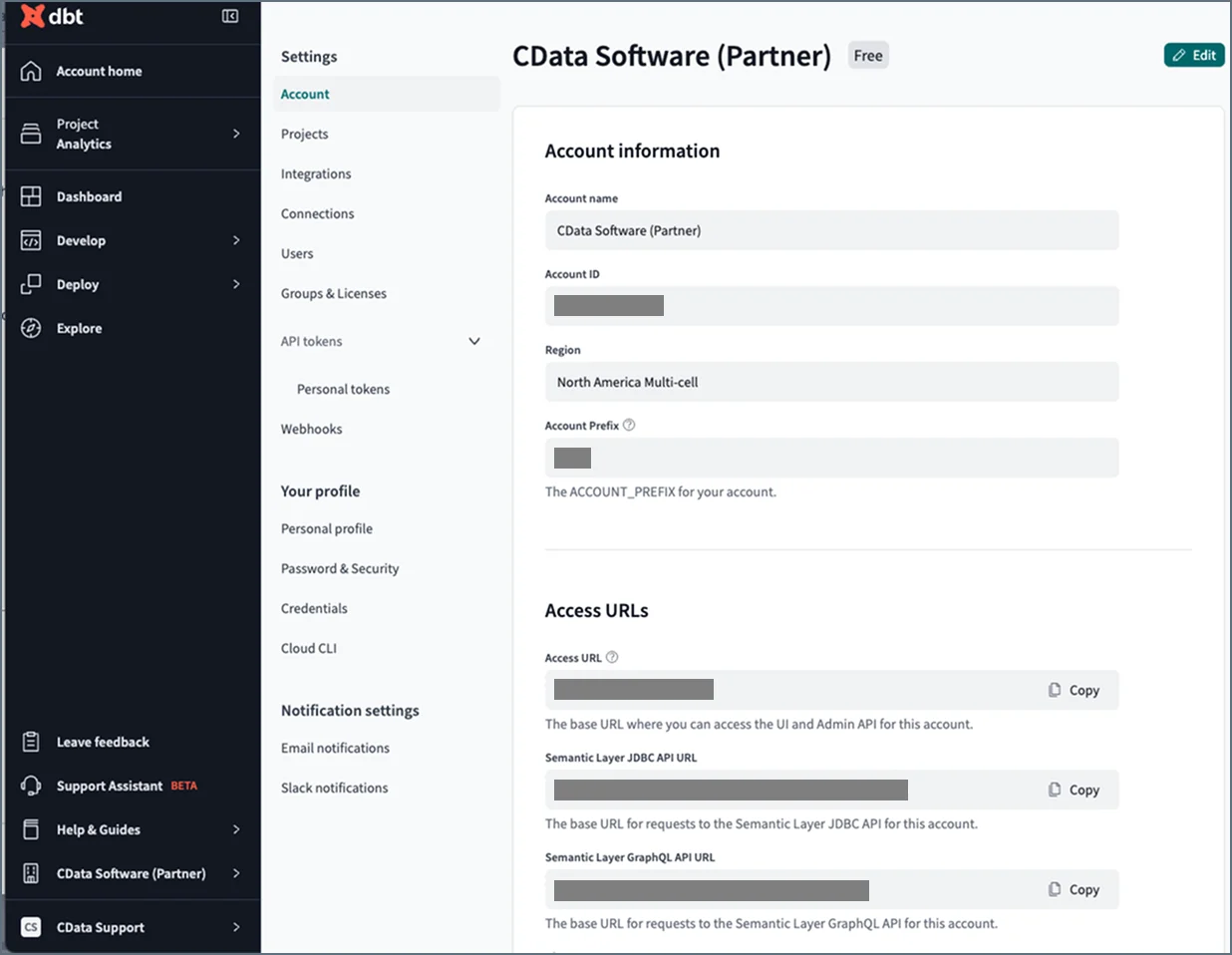
Select Your Profile > Account. Your account Id appears in the Account ID field (in the Account information section), as shown below:
-
Enter either a dbt Cloud personal access token (PAT) or a service token in the Token field.
- If you do not have a PAT, you can create it by selecting Account Settings > API Tokens > Personal Tokens in your dbt Cloud Account Information Center. Copy the new token and return to to paste it into the Token field in the dbt Cloud Settings dialog box.
- If you do not have service token, you can create it by selecting Account Settings > Service Tokens > New Token. Copy the new token and return to to paste it into the Token field in the dbt Cloud Settings dialog box.
-
Enter your base URL in the dbt Cloud Settings dialog box.
 To locate your base URL, open your dbt Cloud Account information Center and select Your Profile > Account > Access URLs. The base URL is listed in the Access URL text box.
 - Click Test Connection to confirm that you are connected. If the connection is successful, click Save to save your information.
Creating a DBT Cloud Transformation
To create a dbt Cloud transformation:- Open and navigate to the Transformations page.
- Select the job on which you want to run a transformation. Then, click Add Transformations.
-
Fill out the fields in the Add Transformation dialog box, as follows:
- Name: Enter a name for your transformation.
- Type: Select dbt Cloud as the transformation type.
- dbt Job: Select a dbt job from the drop-down list.
- Click Add Transformation.
Specifying DBT Transformation Settings
To modify transformation settings, select … > Edit at the end of the transformation row. The settings page contains three tabs from which you can manage settings:Overview Tab
The Overview tab enables you to manage general settings, triggers, and email alerts. You can also see details from the last run of your transformation on this page.Settings Category
The Settings category enables you to specify automatic job retry, logfile verbosity, and command timeout, as follows.-
Select … > Edit at the end of the transformation row. This action opens the Edit Settings dialog box.
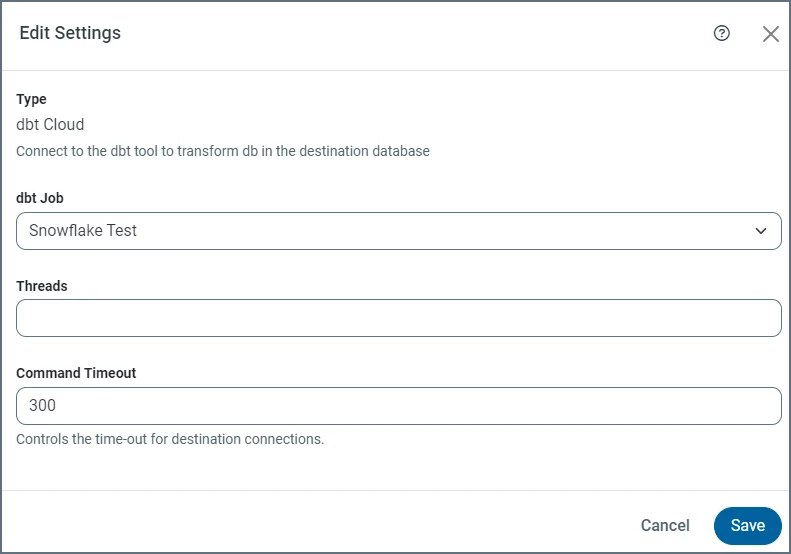
- (Optional) Select Enabled if you want to retry the transformation if one or more tasks fail. Only failed tasks are re-executed.
- Select a level for Logfile Verbosity.
- Enter a timeout value in the Command Timeout field.
- Click Save.
Trigger Category
The Triggers category enables you to set a specific schedule by which to run your transformation, as follows.- Click Configure in the Triggers category. This action opens the Trigger dialog box.
-
Specify the type of trigger that you want. You can select from the following types:
- None—Turns off scheduling options, allowing you to start a transformation manually.
-
Scheduled—Enables you to set a specific schedule by which to run your transformation. This setting also activates the Intervals and Minutes Past The Hour fields. You can choose more granular settings for the Intervals setting:
- Minute—Activates the Every option where you can specify increments in minutes (every 10, 15, 20, or 30 minutes) in which to run your transformation.
- Hourly—Activates a Minutes Past The Hour field so you can set your transformation to run hourly at specific numbers of minutes past the hour (0-59). For example, you might want to run the transformation every hour at 15 minutes past the hour.
- Daily—Activates a Time of Day field so you can set the specific time each day that you want your transformation to run.
- Weekly—Activates two fields (Days and Time of Day) where you can specify a specific day of the week and time to run your transformation.
- Monthly—Activates Day and Time fields. However, for Day, you choose a specific day of each month (values of 1 through 31 or Last Day) along with the time.
- Cron—Activates a Cron Statement field where you can write a cron job to initiate a transformation run.
- After Job—Activates a Job drop-down list that presents a list of all available jobs. You can choose the specific job after which you want the transformation to run. You can also specify various tasks to run on your data by clicking Select Specific Tasks under the Job field. Simply select the task or tasks that you want to run.
- Click Save.
To disable schedule triggers, slide the Trigger toggle switch to the left (the switch turns gray when it is disabled). The toggle switch appears to the right of Trigger in the category box.
Labels Category
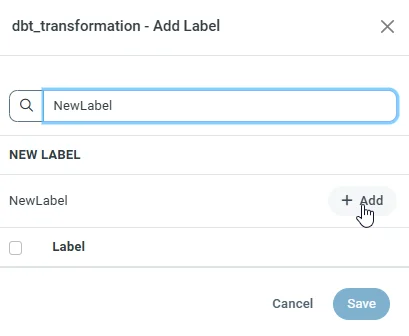
This category enables you to add a label:- Click Add Labels in the Labels category. This action opens the dbtTransformationName - Add Label dialog box. You can search and select a label currently available in the list or you can add a new label.
-
To add a new label, enter the label in the Search or Add Label text box and click Add.
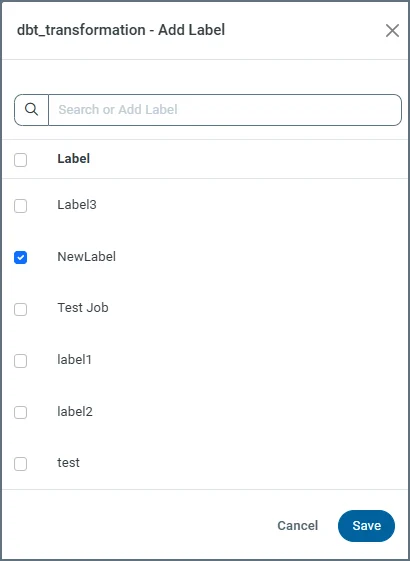
- Click Save.
Notifications Category
The Notifications category enables you to set email alerts for transformations, as follows.- Select … > Edit at the end of the transformation row for which you want to set alerts.
- Click Configure in the Notifications category.
-
Set the following options in the Notifications dialog box:
- To—The email to which to send alerts.
- Subject—The subject for alert emails.
- Errors Only—An option that you can select to specify that alert emails should be sent only when the job encounters an error. If you do not select this option, sends alerts after each job run.
- Click Save.
To disable alerts, slide the Notifications toggle switch to the left (the switch turns gray when it is disabled). The toggle switch appears to the right of Notifications in the category box.